I'm Alberto. I built Fromly.
This is the real story of why. Not the marketing version — the full story, with the names of the apps I tried, the money I spent, and the exact moments each one failed me.
There's a moment I remember clearly. It was a Sunday afternoon. I looked at the $15 charge on my credit card. I opened Roam Research and realized I hadn't used it in three weeks.
Fifteen dollars for nothing.
It wasn't the first time. The same thing had happened with Notion, with Obsidian, with Bear. The cycle was always the same: initial enthusiasm, perfect system built over a weekend, two weeks of intense use, and then... silence. The empty system staring at me from the screen.
For years I thought the problem was me. That I lacked discipline. That if I found the right system, I'd stick with it.
It wasn't me. I had six very specific problems with every app I tried. And none of them solved them.

The app graveyard
Notion, version 1. I built a perfect project database. It took me three hours to set up. I lasted two weeks using it.
Obsidian. The plugins were incredible — also a bottomless pit. I spent more time installing plugins than writing notes. After a month of setup, the system was "ready." And then I barely used it.
Roam Research. Fifteen dollars a month. The block syntax took me a week to understand. When I finally got it, I realized it wasn't for me.
Bear. Beautiful, clean Markdown, and no real sync between devices without paying. Goodbye. Apple Notes. Simple and free, and completely useless once you have more than twenty notes you need to find quickly.
Craft, Logseq, Evernote. The list goes on.
The question I kept asking myself: why do apps this well-built, with so much investment behind them, fail to get people to use them consistently? I eventually arrived at six answers.
Problem 1: they asked me to think before writing
FrictionNotion has databases, views, templates, formulas and table relations. It's an incredible engineering product. And that's exactly the problem.
Every time I wanted to write something down, I had to make decisions: Is this a task or a note? Does it go in the projects database or the journal? What properties does it need? Should I add a due date? What tag does it belong to?
That moment of friction — the second it takes to decide where something goes before you write it — is enough for the thought to vanish. The idea flies before it lands.
The problem wasn't the power of the apps. It was that they asked me to think before capturing.
The brain doesn't work that way. Ideas don't arrive with labels or assigned properties. The best ones come in the middle of a meeting, while driving, in the shower. And any system that asks you to organize them before saving them will always lose against unfiltered thought.
The solution I found: Fromly doesn't ask you to decide anything before writing. You capture, and Fromly classifies on its own.
Problem 2: I was paying for something I didn't use
PriceNotion: $12/month. Obsidian Sync: $10. Roam Research: $15. Craft: $5.
If you use just one consistently, it might make sense. But when the cycle repeats — try, abandon, find the next one — the total starts to hurt. And the worst part isn't the money: it's the guilt cycle. Pay, use for two weeks, abandon, feel bad, cancel, find another app, repeat.
The root problem is you're paying for something you don't use because it's too complicated or heavy to maintain. The app failed to make you a consistent user, but it already charged you.
When I designed Fromly's pricing model I wanted to break that cycle. Free plan with one thousand real nodes — no time limit and no arbitrarily locked features. If it doesn't convince you in real use, you don't pay.
Problem 3: the system that needed maintaining
MaintenanceThe most insidious problem isn't learning to use the app. It's that once you've learned it, you have to maintain it.
Notion needs you to update databases when a project changes. To add properties when a new type of item appears. To archive what's no longer relevant. To keep templates up to date when your workflow shifts.
Obsidian needs you to manage plugins when they update. To check for broken links. To decide what to do with orphaned notes. To reorganize the structure when your main folder becomes outdated.
Every system I tried had the same flaw: it was a second job. Not only did it take your time to organize you — it demanded additional time to maintain the tool that was supposedly saving you time. A perfect irony.
At some point, the system becomes the problem. And you stop using it for exactly that reason.
Fromly has no system to maintain. No databases to update, no templates to manage, no structure to design. The tree builds itself as you use the app.
Problem 4: your notes were hostages
Lock-inOne day I decided to leave Notion. I'd had enough of the databases, the slowness on mobile, paying for something I used less and less.
I exported everything. I ended up with a folder full of Markdown files with Notion frontmatter, images with broken URLs pointing to their servers, and a folder structure that made no sense outside the platform.
Two hours trying to clean that up. I ended up importing a fraction of what I had.
This is lock-in: your notes are yours in theory, but in practice they're tied to the platform. The format is theirs. The images are on their servers. The internal links don't work anywhere else. You've spent years building something that in reality belongs to them.
With Fromly I made a decision from the start: your data is truly yours. Automatic backup every two hours in standard Markdown on your Mac. Any editor can open it. If you decide to leave tomorrow, you take everything. No friction, no broken URLs, no surprises.
Problem 5: the AI that didn't help
Generic AIWhen AI-powered apps arrived, I thought I'd finally found a solution.
Notion AI. Obsidian with GPT plugins. New apps promising "your second brain with AI." I tried them all with high expectations.
The pattern was always the same: select text, press a button, the AI suggests something. Summarize, expand, rephrase. It works technically. But it doesn't solve the real problem.
The real problem isn't that I need AI to write for me. The problem is that I have hundreds of notes and can't find what I'm looking for. That I captured something three weeks ago and don't know where it is. That my tasks are scattered across ten different places with no unified view.
An AI that rephrases text solves none of those problems.
What I wanted was an AI that knew my notes. That could tell me what I'd written about project X without me having to search. That classified everything automatically into the right context. That remembered who I am, what projects I'm running, what people I mention frequently.
I didn't want ChatGPT on top of my notes. I wanted something built from within.

Problem 6: my notes in seven different places
FragmentationAt one point I had this:
- Apple Notes for quick things on my phone
- Notion for work projects
- Bear for personal notes
- A Google doc for shared team stuff
- Voice memos on my iPhone I never went back to listen to
- WhatsApp to myself for ideas on the go
- Physical notebooks for meetings
Seven different places. None complete. Everything fragmented.
The fragmentation problem is subtle but devastating: if you don't know where something is, it's as if you never had it. And if you have to search seven different places every time you need something, the system stops being useful.
Fromly's premise is one tree for everything. Not one app for work and another for personal. Not quick notes in one place and projects in another. One single place where everything coexists, with contexts that separate what you need to separate without breaking the system.
You capture on your iPhone, it appears on your Mac in seconds. You write in today's journal, Fromly classifies it in the right context. One system, always up to date, without configuring anything.
The insight that changed everything
The problem wasn't me. And it wasn't exactly that the apps were bad — many are excellent products.
The problem was that they all started from the same wrong principle: decide the structure before capturing the content.
Databases, templates, folders, note types. All that scaffolding is for organizing — but it only makes sense once you already have the content. Put it in front of the capturing step and it becomes a filter that leaves out exactly the most valuable ideas: the ones that arrive without warning and need a home immediately.
I wanted a tool that worked the opposite way: write first, organize later. That understands what you write without you having to explain it.
That classifies on its own. That remembers. That acts. Without you having to decide anything before opening the keyboard.
How Fromly was born
The first version was terrible. A simple outliner: no AI, no contexts, no sync. Just a tree of notes on the Mac.
I used it for three months to see if it held up day to day. It did. The outliner — the idea that everything lives in a hierarchical tree you can expand and collapse — turned out to be the right format for how I think and work.
I kept adding layers: the automatic journal (a note for each day, without creating it manually), sync between devices, search with highlighting, and finally AI — built from within, not glued on top.
The most important thing I learned in the process: AI has to understand the user's context, not just the current text. That's why Fromly builds a profile from what you write, learns the projects and people that appear frequently, and automatically classifies each note into the right context. No menus. No decisions beforehand.
Each context builds up its own knowledge: keywords, people, recurring topics. Fromly extracts it and keeps it up to date as you write more.
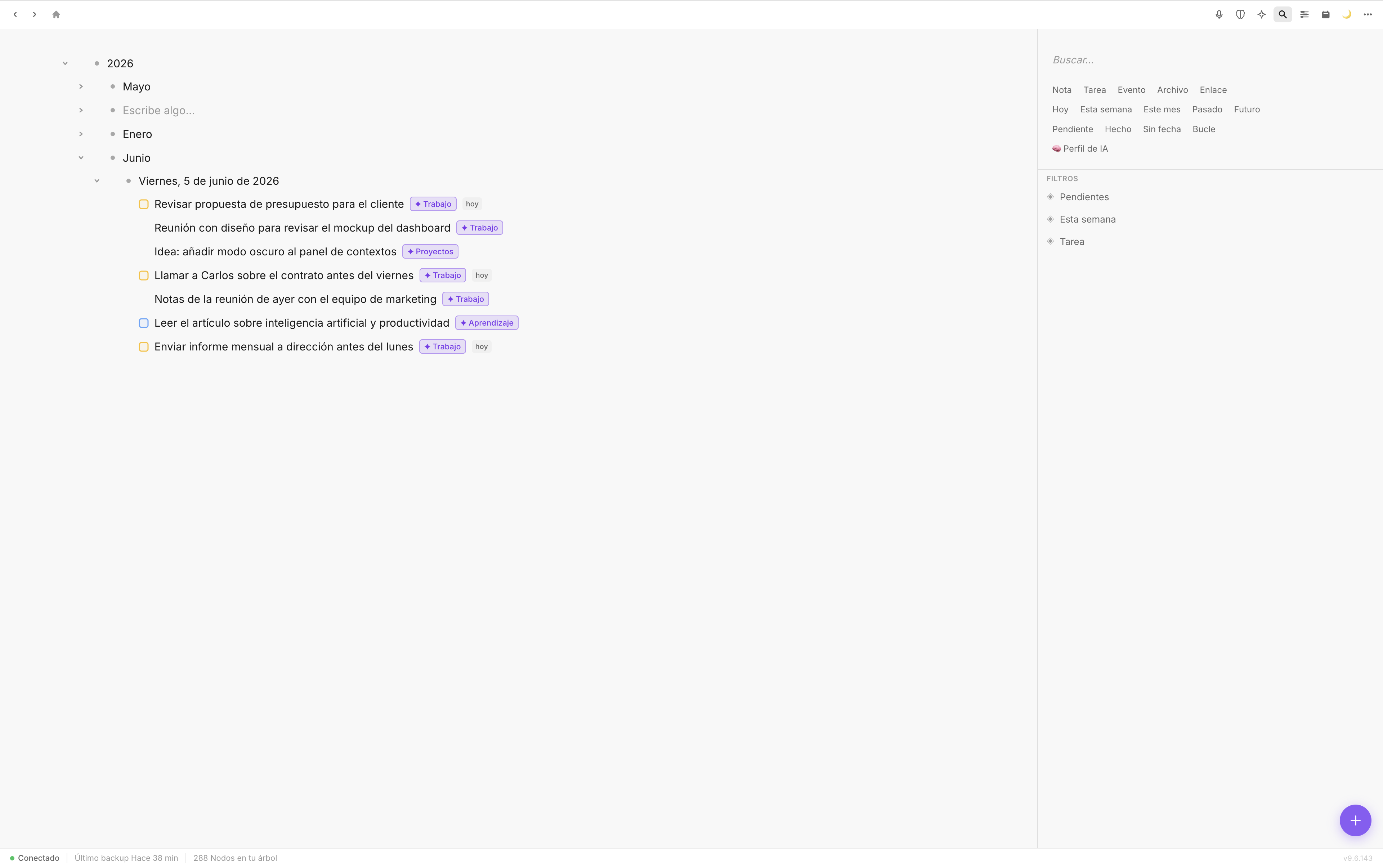
I've been using Fromly daily for over a year. It's the first notes app that's lasted more than six months. Not because it's perfect — there's a lot to improve and I know it — but because it doesn't ask anything of me before letting me write.
What Fromly solves
The six problems → the six solutions
If you've recognized yourself in any of these problems — if you've spent years trying apps and abandoning them — I invite you to try it.
And if you want to share your story: which app you stuck with longest, what made you abandon it, or what you'd like Fromly to do that it doesn't do yet — write to me directly through the contact form. I read them myself.
Try Fromly for free
No credit card. No time limit. One thousand real nodes to start today.
Create free account →