The problem with flat tags
Most productivity tools ask you to tag your notes. You have a task about "La Isla del Trading" and you mark it with #work and #laIsla. It makes sense… until you have fifty tags and can't remember which one you used that time you jotted something down about the May launch.
The problem isn't that tags are bad. The problem is that they're flat. They don't know that "La Isla" lives inside "Work". They don't understand that when you write "call Jota about the Squad" that belongs to a specific context, not floating in space.
Fromly works differently. It understands that your projects have hierarchy, and classifies accordingly — without you having to lift a finger.

Fromly organizes your information in a real hierarchy, not a flat list of tags.
How hierarchical contexts work
In Fromly, everything you write lives inside a context. On the left you have your Areas — the big blocks of your life, always active: work, personal, family. Inside each area, your Projects, which you can archive once you no longer need them. It's the same structure you already use to think about your life: big areas, and inside them, the concrete stuff.
When you create a task inside the "La Isla del Trading" context, Fromly knows that task belongs there. You don't need to tag it. You don't need to move it to a folder. You just write it in the right context — or tell the chat — and Fromly finds it whenever you need it.
This sounds simple. But the practical difference is huge:
- When you filter by "work", Fromly shows you everything inside that area — including everything inside each project.
- When you search "Squad", Fromly knows that word appears in the La Isla context, not in MiTrading's.
- When you ask the chat what's pending this week, it answers with the full context — not a headless list of tasks with no idea which project they belong to.
A concrete example
Imagine you have this structure in Fromly:
- Work (area)
- La Isla del Trading (project)
- June launch
- Call Jota — follow up on email sequence
- Prepare Monday's market report
- Media Sector (project)
- Serviciospararadios proposal
- La Isla del Trading (project)
If you filter by "pending" inside the La Isla context, Fromly shows you only that project's tasks. If you filter globally by "pending", it shows you everything — but grouped by its original context. You always know where each thing comes from.
No ambiguity. No tags to maintain. No task floating without a context.
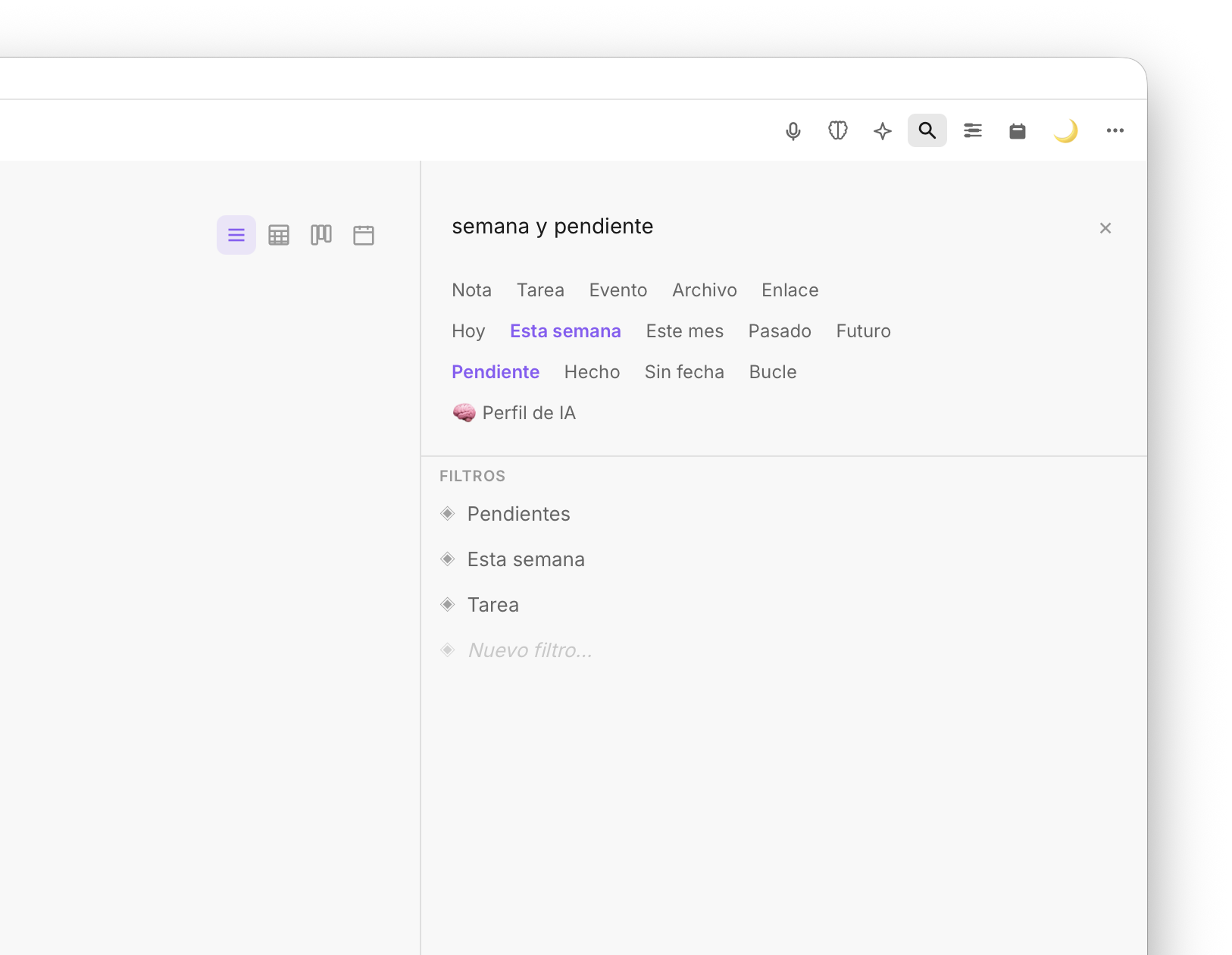
Filters in Fromly respect the hierarchy: filter by context, type, status, and more — without leaving the chat.
The chat understands the hierarchy, not just the words
When you ask Fromly's chat something, it's not searching keywords in a flat index. It understands where each thing lives. If you say "what's pending for La Isla this week?", it knows exactly which context to look in. It doesn't confuse a MiTrading note with a La Isla one. It doesn't mix contexts.
This is what sets Fromly apart from conventional text search. Hierarchy is part of the model. It's not decorative.
Fromly isn't just a chat with memory. It's a tool that understands the structure of your life and works within it — not against it.
How to get the most out of it from day one
You don't need to redesign your organization system. Just start with a minimal structure that reflects your real areas:
- Create an area for each main block of your life (work, personal, learning).
- Inside each area, create a project for each active thing.
- Write tasks and notes directly inside the right context — no extra tags needed.
Fromly does the rest. When you need to see everything pending on a project, you filter inside that context. When you want a global view, you use the Planner or ask the chat. The hierarchy is always there, working quietly in the background.
Hierarchical organization isn't an advanced Fromly feature — it's how it understands the world. The sooner you adopt it, the less time you'll waste looking for things that should already be right where you left them.