Two tools, two opposite philosophies
Obsidian is an extraordinary tool. If you're a researcher, an academic writer, or someone who's spent years building an elaborate note system with backlinks and plugins, Obsidian is probably the best thing out there. But if what you need is to capture a task, organize your week, and have your tool understand what you write without configuring anything, the story is different.
In 2026, the question isn't which one has more features. It's which one lets you keep thinking without interrupting you.
The real problem with Obsidian for day-to-day use
Obsidian is powerful because it's infinitely configurable. That's also its problem. To get value out of it you need to:
- Choose and maintain a folder or tag system
- Install and update third-party plugins
- Design templates for each type of note
- Manually decide whether something is a task, a note, a project, or a journal entry
None of this is bad if you have the time and energy for the system itself. But if what you want is to write and have the tool follow you, Obsidian puts you to work for it before you can work for yourself.
Obsidian's hidden cost isn't money. It's the mental energy you spend maintaining the system instead of using it.
Fromly: tell it, and it understands
Fromly starts from a different premise. There are no folders to design and no note types to configure. You write in the central chat, and the AI detects what each thing is and which context it belongs to.
Write "Call Javier tomorrow at 10" and Fromly logs it as a task with a date. Write freely about what's on your mind and it's treated as a note. Add a link or a PDF and it's saved as a file. There's no type to pick, no property menus, no templates to set up beforehand.
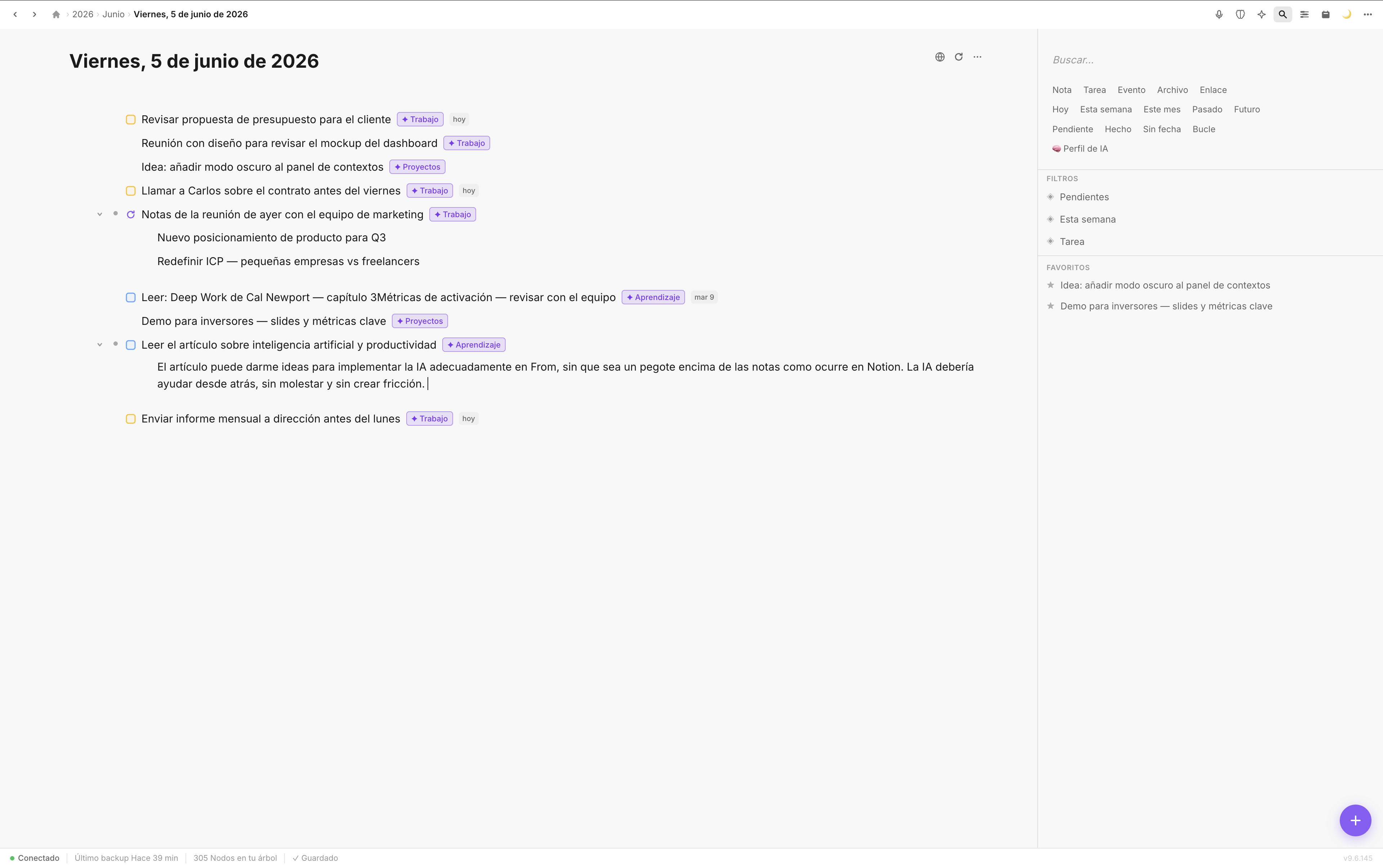
Fromly organizes everything by context: notes, tasks, and events coexisting without friction, each in its Area or Project.
This detection isn't generic magic. Fromly recognizes natural-language patterns: relative dates, action verbs, URLs, the context of what you're writing. You don't need to learn a special syntax or remember any command. You write the way you think, or just say it out loud.
The real workflow: capture, organize, plan
Where Obsidian asks you to decide before you write, Fromly lets you write first and organizes after. A typical Fromly flow:
- You open today's note and dump everything on your mind
- Fromly detects tasks, dates, and files automatically
- You filter by pending to see what you need to do today
- The planner shows you what's coming up this week
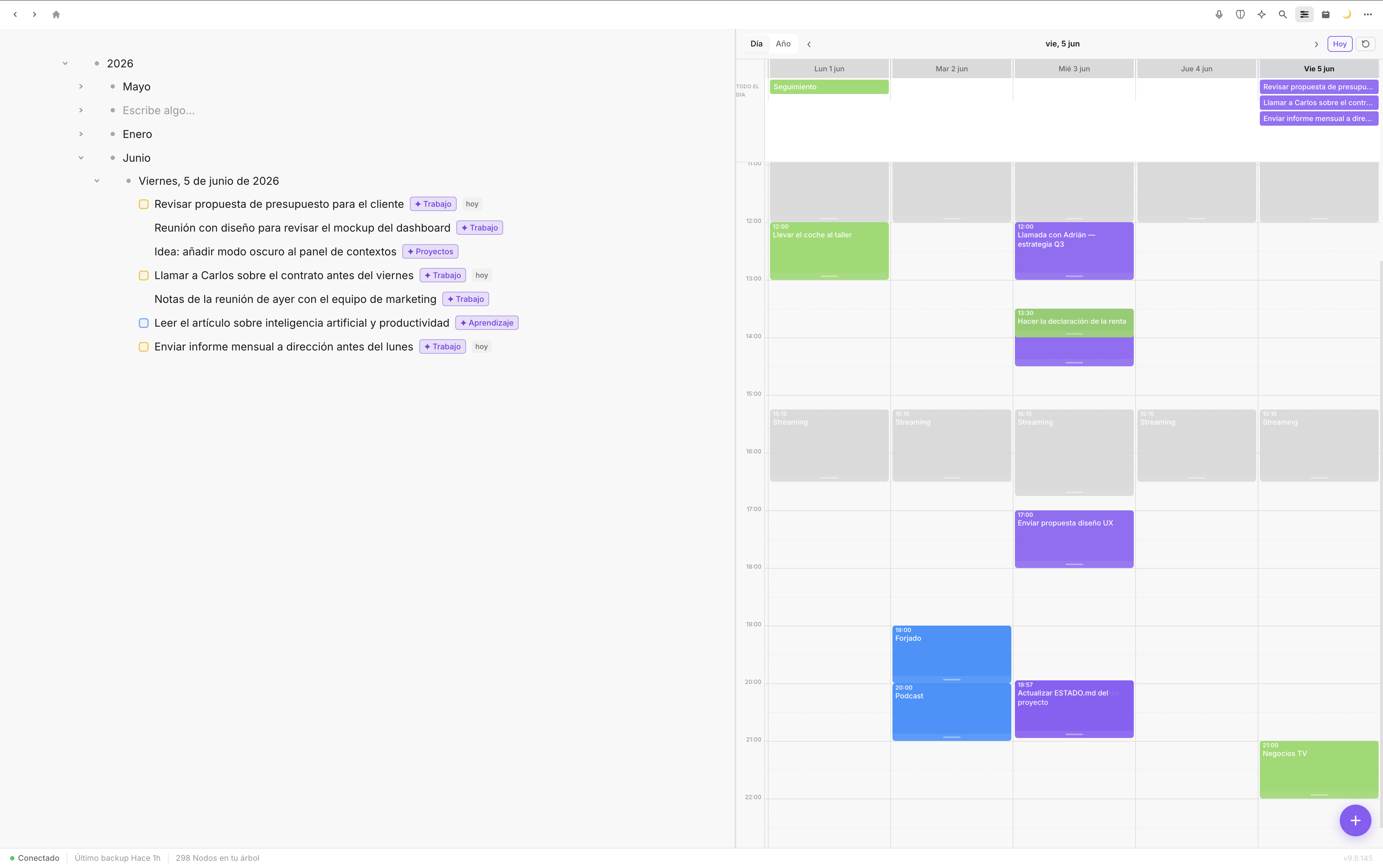
Fromly's planner shows your tasks and events without you having to manually reorganize anything.
There's no "configure the system first" step. That flow works from day one, with the structure you already have in your head.
What about filters and search?
Obsidian has powerful search, but it requires knowing its syntax. In Fromly, the fastest way is to just ask the chat directly — "what do I have pending this week?" — and it answers with what you already have saved. If you'd rather explore on your own, Elements has natural-language filters and visual chips you can combine without writing a single query.
For someone who wants to find "this week's tasks related to project X", Fromly solves it in two clicks. In Obsidian, you need to know the right operator or have a plugin configured for it.
When to choose Obsidian
Let's be honest. Obsidian is still the best option if:
- Your main work is writing and connecting ideas long-term (research, books, essays)
- You need a knowledge graph with complex backlinks
- You already have a mature vault you don't want to migrate
- You enjoy configuring and optimizing your note system as a hobby
When to choose Fromly
Fromly is the right choice if:
- You mix notes, tasks, and planning in the same workflow
- You want to capture fast without deciding where each thing goes
- Your problem isn't your note system — it's getting the important things done by the end of the day
- You want the tool to adapt to how you think, not the other way around
Fromly doesn't compete with Obsidian on note depth. It competes with the time you lose thinking about your system instead of your work.
Conclusion
Obsidian and Fromly solve different problems. If your challenge is capturing, organizing, and executing without friction day to day, Fromly wins without question: you write, and it knows what to do with what you wrote. If your challenge is building a deep, lasting knowledge base, Obsidian is still unbeatable. Choose the tool based on the problem you need to solve, not on which one has more features.